

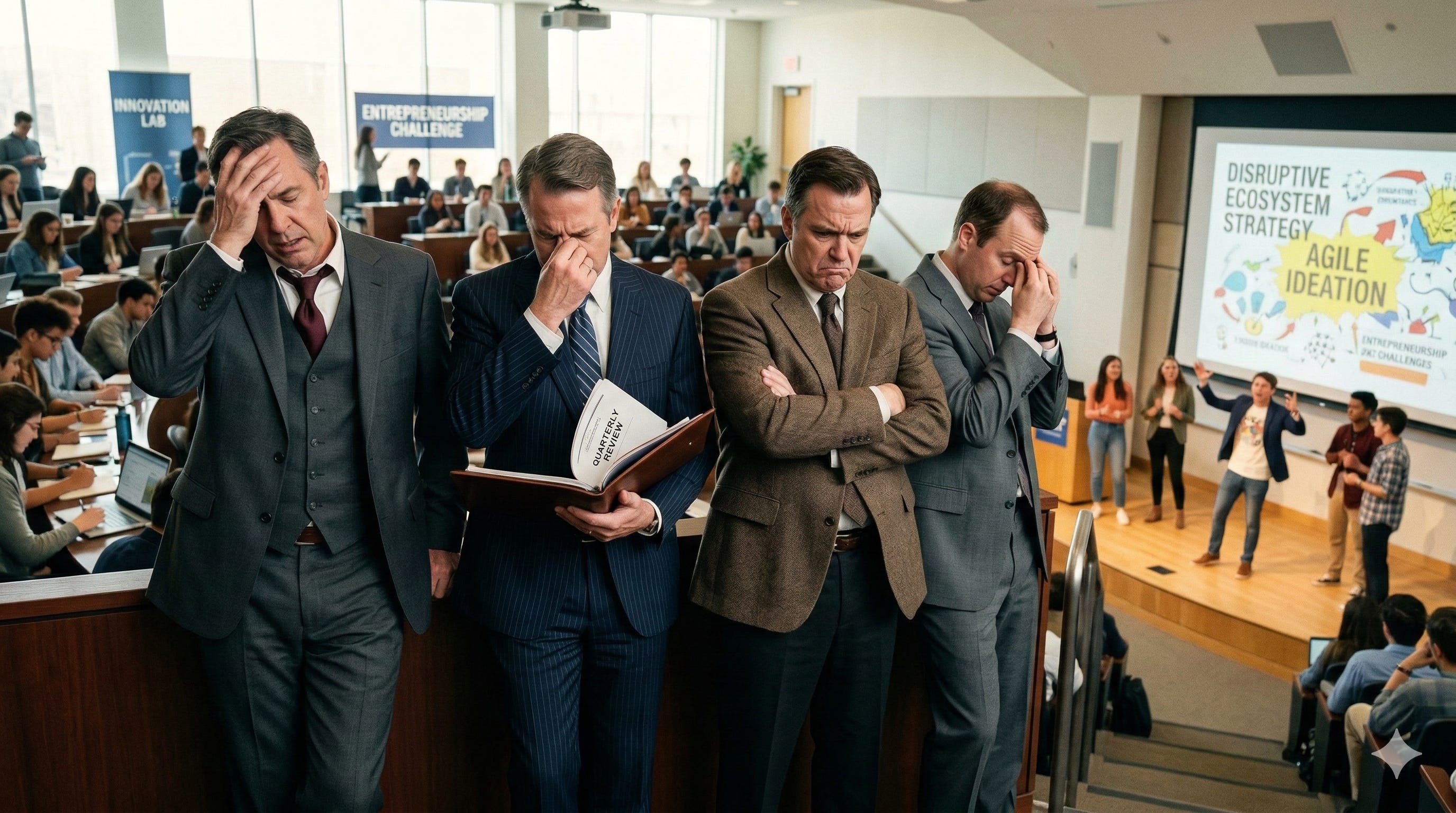
Every few months I hear some variation of the same complaint from executives: business schools aren’t producing the right people anymore. Graduates are too polished, too theoretical, too dependent on frameworks, too slow when reality refuses to follow the slides.
I don’t completely disagree. But I also can’t help noticing a small irony. The same companies that complain the loudest are often the ones who believe their role in education begins and ends with sponsoring a chair, funding a research center, or showing up once a year to deliver a keynote about “the future of the industry.” A nice logo on a brochure, a handshake with the dean, maybe a LinkedIn photo, and everyone goes home feeling that some sort of bridge has been built.
It hasn’t.
If companies genuinely believe the talent pipeline isn’t working, the answer is not another sponsorship. It’s co-design. And that’s a much more uncomfortable idea.
What I mean is something far less ceremonial and far more operational. Executives helping define what good work actually looks like. Students working on problems that are messy, incomplete, and occasionally annoying. Deliverables that have to survive contact with people outside the classroom. In other words, the kind of work environments graduates will encounter about five minutes into their first job.
In my own courses I’ve been experimenting with fragments of this. Students pitching beverage products to an actual distillery owner instead of to me, where students quickly learn what survives contact with a real market and the producer gains fresh positioning ideas from outside his own industry bubble. Design sprints that take place in hospitals or hotels where the frictions are real and observable, forcing students to decode how people actually move and hesitate in complex environments while the organizations themselves gain dozens of practical micro improvements they rarely have the time to explore internally. Effectuation projects in seemingly barren territory like last mile delivery, where students must identify opportunities using only the resources already available around them and defend their thinking directly to senior operators, who in return get exposed to unconventional angles and reframings of operational problems they deal with every day. Or local social impact programs linking proximity NGOs with the school’s own management, allowing students to design initiatives that could realistically be implemented while gently reminding institutional SDG teams that meaningful impact sometimes exists just outside the campus walls, not only in distant partnerships that look good on a sustainability report. Teams trying to fix small operational problems under constraints rather than producing immaculate slide decks about hypothetical strategies.
The change in behavior is immediate. When students know they are performing for a grade, they optimize for safety. When they know someone from the real world is watching, they start optimizing for judgment. The difference between those two instincts is enormous.
None of this is a magic solution, and it’s definitely messier than traditional teaching. It requires companies to invest time instead of just money, and it requires schools to open the classroom door wider than they usually feel comfortable with. Bureaucracies are not famous for enjoying that sort of thing.
But if industry truly wants better prepared graduates, outsourcing the entire formation process to universities while commenting from the sidelines is probably not the winning strategy.
Funding education is easy.
Co-designing it is where things start to get interesting.