

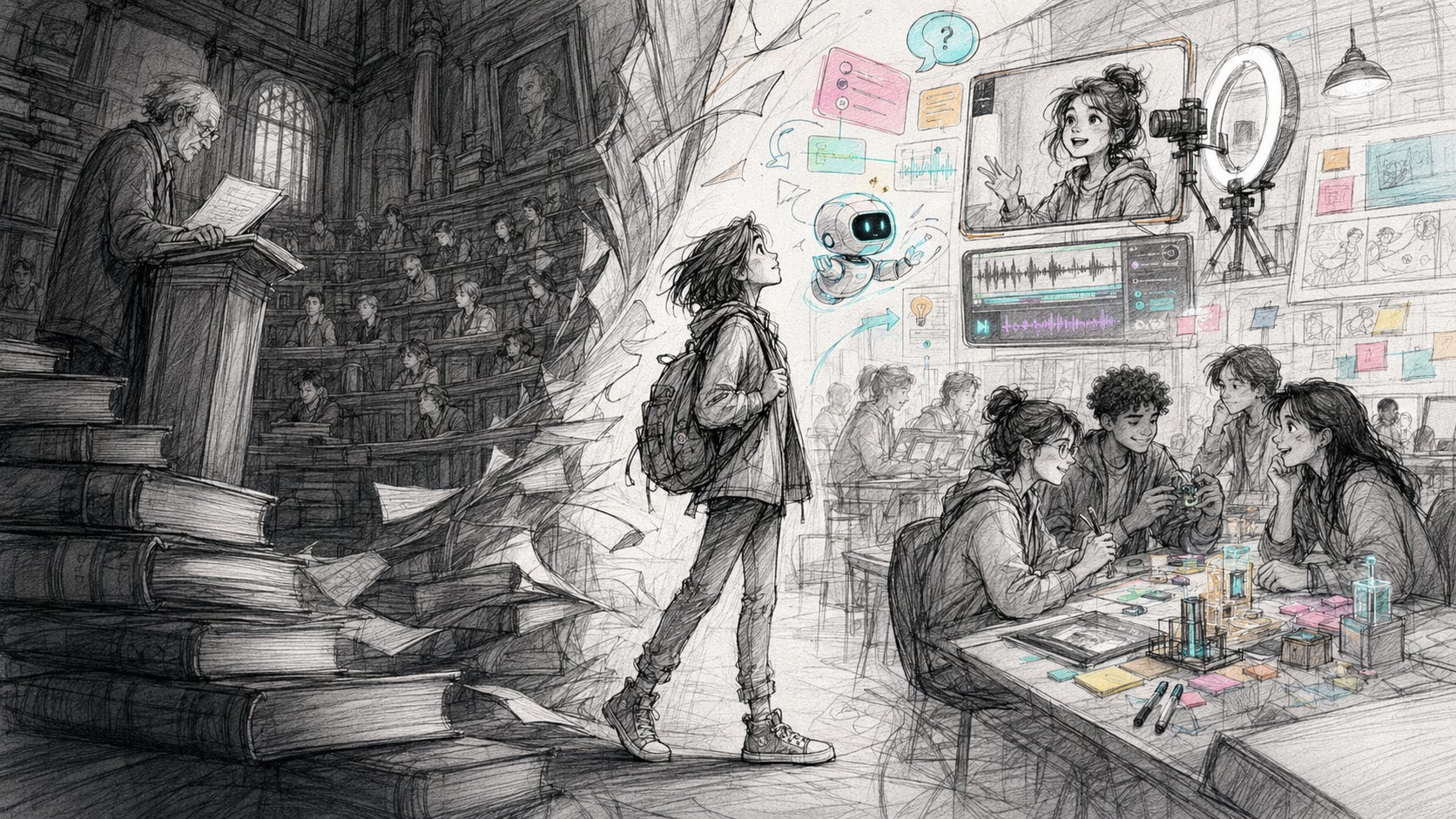
I admire the research behind AI powered instructional video. Making course videos searchable, interactive, question driven, and tied to the class context is smart. The OpenAI education powered initiative (cuGPT / Rutgers) points in the right direction: video should not just sit there like digital furniture. Students should be able to interrogate a video, revisit a concept, ask for another example, and prepare better before class.
But here is where I get allergic.
Student satisfaction with video does not automatically mean meaningful learning. It may only mean the video was less painful than the alternatives. That’s a very low bar. HigherED has a dangerous habit of confusing usage with value, “students liked the video” does not automatically mean “students learned.” Sometimes it only means the video was less painful than the textbook, the recorded lecture, or the professor reading bullet points like a hostage note.
The real issue is not video. It is format.
Students watch short videos all day, and yes, plenty of it is intellectual junk food. But the people making that junk understand rhythm, tone, hooks, pacing, compression, faces, sound, and the sacred violence of the first three seconds. Academia still thinks a forty minute recorded lecture with bad lighting is innovation because someone uploaded it.
If I had the resources, I would not produce learning videos like a professor. I would bring in someone who knows how to stop the scroll. Then I would pair them with someone who can write sharp vulgarisation. Together, we would break down Porter, Christensen, Blank, Jobs To Be Done, positioning, business models, effectuation, and customer discovery into short, punchy videos built around one idea, one example, and one decision students must make.
Not to dumb it down. To make serious ideas travel better.
AI would sit around that content: summaries, quizzes, counterarguments, retrieval practice, “explain this differently,” “challenge my answer,” “prepare me for class.” Then the next session would turn the video into a workshop where students apply, test, defend, and improve the idea.
That is HigherED powered by AI.
But higher education mostly wants the technology without the redesign. It wants AI without letting go of the old book driven model. Once in a while, someone tries to be hip, and we all know what happens: a podcast appears, a video series appears, a platform appears, and within weeks it smells like a committee discovered Canva.
The real move is harder. Bring the new generation into the room. Let them help build the format for the generation we are teaching. Not to lower the level. To increase the reach.
But that requires letting go. And higher education is very bad at that.
It wants the technology, but not the cultural shift. It wants AI, but not the redesign. It wants engagement, but not the discomfort of admitting that most academic formats were built for a world that no longer exists.
That is why this matters.
Not because video will save higher education. Because the way higher education handles video tells us exactly why it is in trouble.
I frequently run into issues in university tutorials, where dopey graduate students fumble around trying to get basic responses from their classes. They could get a lot more if they had even some basic scaffolding to build off of.
My belief is that using AI with real world professoring (I think I may have just created that word!) can be quite effective as each can enhance the other. I often thought that courses like corporate finance could be taught using recordings from the best of the best professors (e.g., Damodoran from NYU - I adored that class & still think of is decades later), complimented by a local professor that students interact with in the flesh. AI just adds another dimension to this by enabling individual interaction at a scale humans can't match. Add to that that we all learn differently - my wife learns more from hearing whilst I'm more visual (it's why she speaks 5 languages and I struggle with 2). AI can learn what works best at an individual student level that ensures a better learning outcome, when coupled with traditional learning.
Oh, and the big classroom where professors call on students should never be replaced! It forces one to come prepared (or risk embarrassment), plus, students do learn from other students for all of us think & process information differently.
The fact that you're thinking this way, Andrew, is 90% of the battle. I pity to kids that sit through the "Bueller Bueller" type professor who drones on for 50 minutes on autopilot.
(referencing the scene from Ferris Bueller's Day Off - a classic for us gen Xers)!