

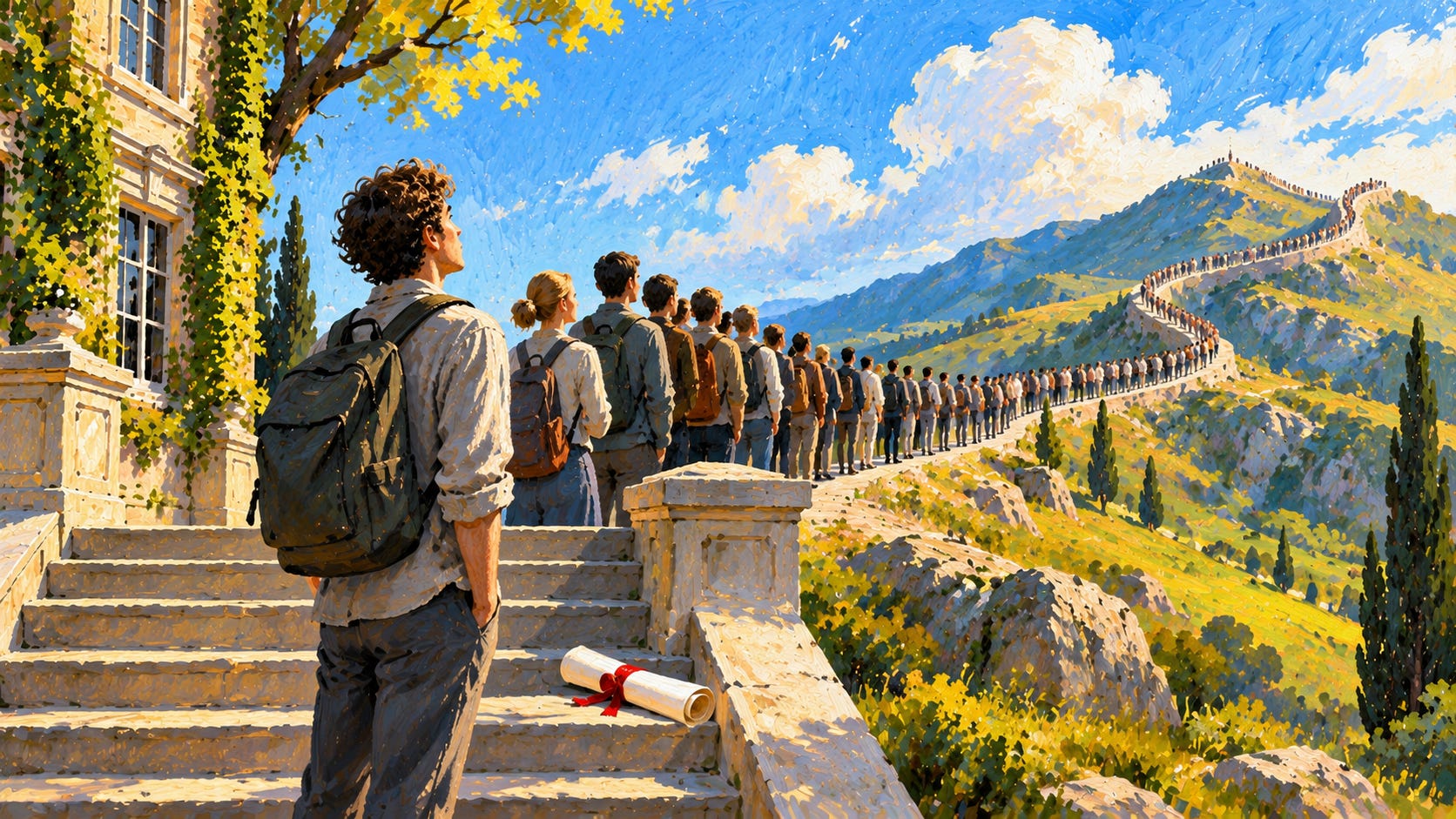
Many graduates did exactly what we asked of them. That is precisely why the bargain is becoming harder to defend.
Ismael Sanz recently described the feeling of betrayal: study, borrow, graduate, and discover that secure employment and an independent life remain out of reach. In The New York Times, Noam Scheiber traces the problem further back than the current AI panic. In America, the promise of a secure professional career was already weakening, long before chatbots arrived.
The numbers give that frustration a shape. In the second quarter of 2026, the New York Fed estimated that 42 percent of employed recent American graduates held jobs that typically do not require a degree. European studies use different measures but reveal their own problems with graduate overqualification. That doesn’t mean their education was wasted. It does mean the familiar equation between education and security deserves an uncomfortable examination.
I recognise the feeling from another life. When I played professional tennis, being ranked among the world’s top 500 sounded rather impressive at the time. Until I discovered how many extraordinarily talented players were still ahead of me, and how few could actually earn a living. I’d climbed a very considerable ladder. I just hadn’t arrived where I thought I had.
And isn’t that a recurring illusion throughout life? The degree, the job, the house, even retirement. We keep imagining there’s a point at which we’ve finally arrived, only to discover another climb, another queue, another set of rules.
So a degree still matters. But when ever more people are encouraged to earn one, the qualification can become the ticket to a longer queue rather than an advantage at the front of it.
Life will always contain unexpected competition and uncertainty. Universities cannot eliminate either, nor can they build houses or manufacture vacancies. But they should prepare students for that reality rather than reinforce the illusion that a qualification is the finish line.
I recognise another part of the problem inside my own profession. We still reward students for following a brief, reproducing a framework, and delivering an immaculate presentation. I’ve assigned enough handsome slides myself to know how seductive that is. Employers then ask graduates to make decisions when information is contradictory, resources are missing, and nobody has written the instructions. AI makes the presentation easier. It does not take responsibility for the decision.
And that’s the whole point.
Over the past year or so, I’ve fundamentally changed the work I ask students to do; and boy, does that get me some pushback!
In a recent MBA course in Berlin, I challenged teams to create new value inside existing organisations with no additional money, people, or technology. No convenient blank sheet. They had to uncover overlooked resources, confront real human problems, make uncomfortable tradeoffs, and defend decisions based on incomplete evidence. Above all, they had to do more with less, without knowing whether their chosen direction was right.
The resistance was real. Some wanted more examples, clearer answers, greater reassurance, or the entire course mapped out before making decisions. I understood the frustration. Really. After years of being rewarded for following instructions and finding the expected answer, suddenly being asked to take responsibility for decisions without certainty can feel like the professor isn’t doing his job.
And I had to question myself too. Providing clarity about the task and assessment is my responsibility. But, more importantly, providing certainty about the decisions would defeat the purpose.
By the final defence, I’d even taken away their slides. They had to explain their reasoning, defend the evidence, acknowledge what remained unknown, and face difficult questions from their peers. No rescue from the professor. No imaginary resources to make the problem disappear. Considerably less comfortable than presenting a beautifully illustrated strategy for spending somebody else’s money.
In another course, in Nice my B4 students investigate real retail environments before developing and defending a foreign market entry strategy before an industry jury. Their ideas must survive actual shelf conditions, commercial arithmetic, and questions from people I bring in who know the business backwards. Suddenly a beautiful bottle is not a viable business model!
Most importantly, I want students to encounter ambiguity, scrutiny, disagreement, and consequences while someone is still there to challenge their reasoning. After years of being rewarded for finding the expected answer, why would we expect them to embrace uncertainty overnight?
None of this guarantees employment, of course. Nor does it excuse universities from providing serious career guidance, employer connections, and a more honest conversation about what a degree can deliver.
But surely, if a degree has become a ticket to a longer queue, the least we owe students is an education that prepares them for more than standing in it.