

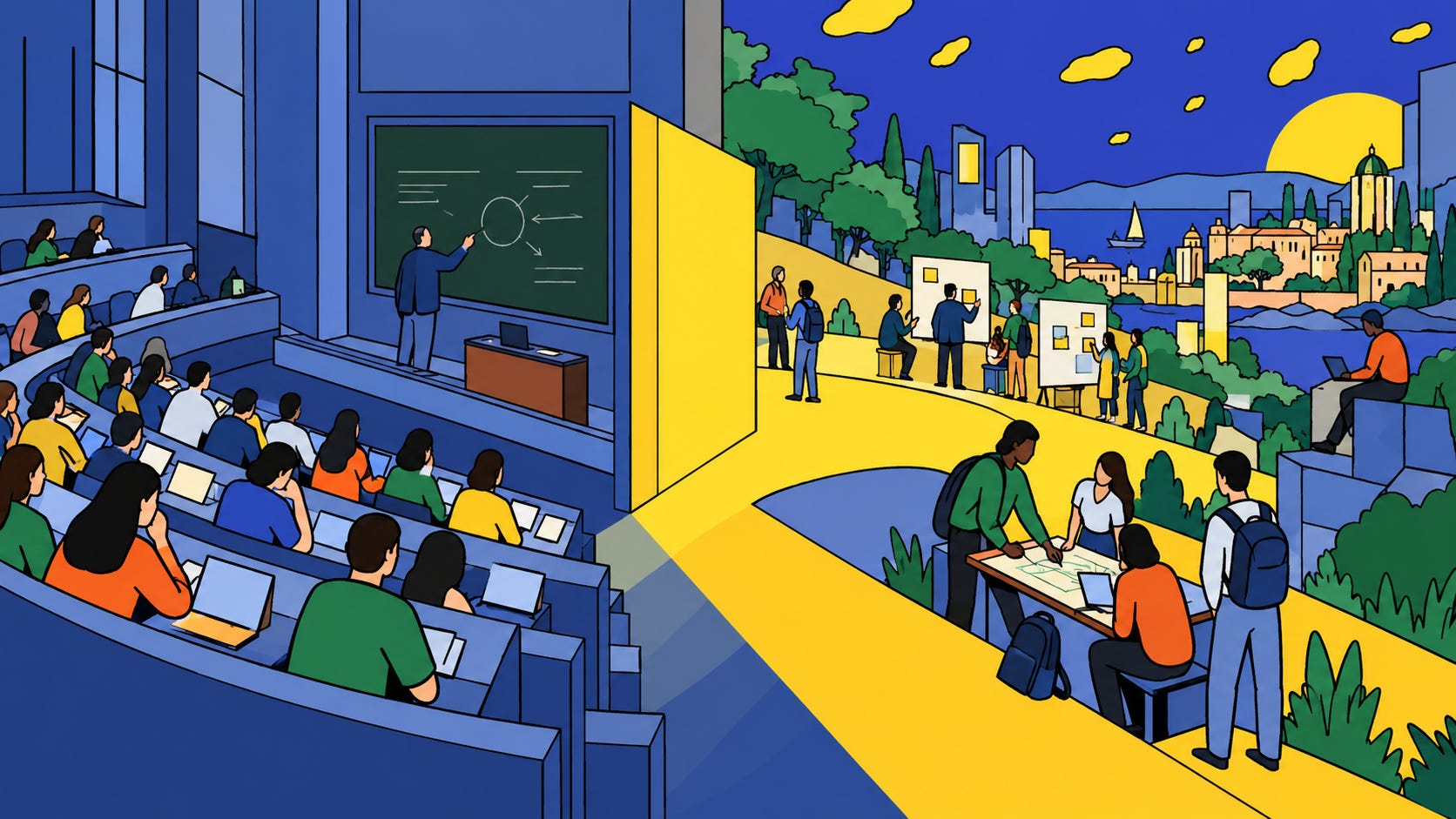
Universities still measure education in hours.
That made sense when knowledge was scarce, professors were the distribution system, and learning meant being in the room. But AI, better pedagogy and experiential learning are changing the relationship between classroom time and capability.
I see it in my own courses. I am removing lectures, shortening explanations, and pushing students into fieldwork, decisions, experiments and live defenses. AI can help them understand today a concept in minutes that I might once have spent half a class explaining. But the interesting part begins afterwards: what can they do with it?
Here’s the uncomfortable bit. If I can help students build greater capability with less scheduled classroom time, the institution does not naturally benefit from making the course shorter.
The inconvenient truth is that higher education is organized around time. Credits, contact hours, teaching loads, timetables, contracts and semesters depend on it. Hours are easy to allocate and audit. Capability is not.
That creates a strange incentive: better learning can become more material squeezed into the same hours, instead of a reason to question the hours themselves.
This is not an argument for shorter education. Students still need time to struggle, observe, test, fail, revise and defend. But much of that is learning time, not lecture time.
So I am increasingly moving time from receiving to doing.
If we can produce more capability in less classroom time, higher education eventually has to confront a difficult question:
Are we designing around how students learn, or around the hours institutions know how to count?