

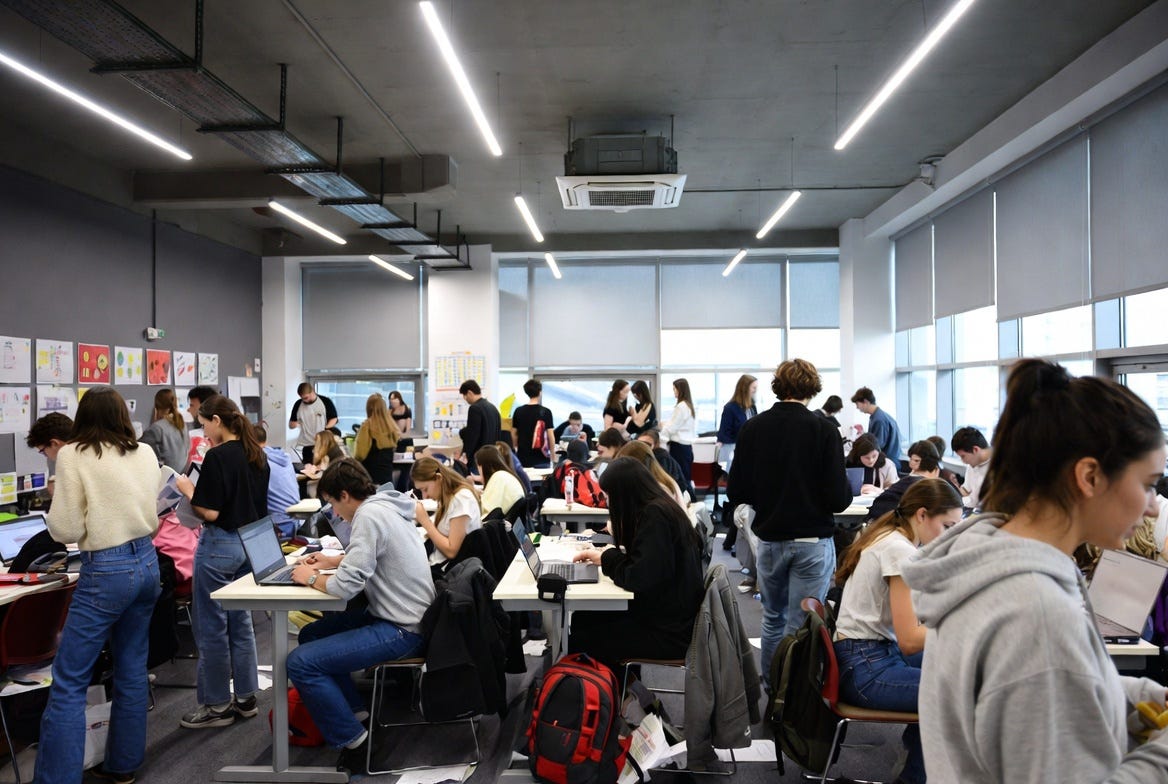
I’m teaching a class right now with more than 55 students in the room, and every time that happens, I have the same thought: this is not really teaching anymore, this is crowd management with slides. You’re basically performing. You’re a guy with a clicker, a voice, and a PowerPoint deck trying to keep a small human avalanche vaguely pointed in the same direction.
And look, I understand the logic. I’m not naïve. Business schools are businesses. Rooms get filled, timetables get compressed, cohorts get bundled together, and on paper it probably all looks beautifully efficient. But in real life, in the room, with actual human beings and actual attention spans, it starts to break down very quickly.
And no, slides are not magic. Students cannot catch ideas as they whizz past them like dry leaves in the wind. Real teaching is slower than that. Messier too. It is a pause, a question, a bad answer, a better follow up, a scribble on a piece of paper, me leaning over a table and saying, “No, hang on, you’re mixing up the problem and the solution.” That’s where the learning happens. Not in slide 27.
That does not happen with 55 people. Or not well, anyway.
For me, the sweet spot is somewhere in the early to mid twenties. Big enough to create energy, small enough that I can still get close to people, read the room, push a team, calm another one down, and actually help someone over a hurdle. Once you get far beyond that, the whole thing changes. Yesterday, before the break, I had barely made it around the room. A few teams had not seen me for more than an hour. An hour. In a class they are paying serious money for. That’s absurd.
So what do I do when schools keep stuffing the room? I fight back a bit. Post its. Loose paper. Get up. Move. Talk. Ask them to borrow pens from each other because apparently half the class now shows up to university like it is a lounge, not a classroom. I build in two or three mini breaks in a three hour block. I go grab coffee with them. I herd them back in like a sheepdog (and believe me, that’s real contact!) It helps. Of course it helps. But it’s still compensation. It’s still me trying to outsmart a structural problem that should not be there in the first place.
Not elegant, maybe. But at least it still feels human. And that’s really the point, isn’t it? If business schools are supposed to be in the business of learning, why are so many of them still organised around efficiency, when learning itself is anything but efficient?